
How Much Does Collagen Supplement ODM Cost?
The cost of collagen supplement ODM manufacturing cannot be represented by one universal price. Unlike purchasing a ready-made supplement from a wholesaler, ODM manufacturing can involve formula development, ingredient selection, sample adjustments, dosage optimization, packaging customization, product testing, and commercial production.
Two manufacturers may quote different prices for products marketed as collagen supplements because the products may contain different quantities of collagen peptides, use different raw material sources, require different manufacturing processes, or include different testing and packaging services.
A practical ODM cost formula
Total Project Cost = Formula Development + Raw Materials + Manufacturing + Packaging + Quality Testing + Compliance Support + Logistics + Applicable Setup Costs
ODM vs. OEM vs. Private Label: Why Pricing Differs
Private label manufacturing typically starts with an existing formula that can be sold under a buyer's brand. OEM manufacturing generally focuses on producing a formula according to the buyer's specifications. ODM manufacturing may include product concept development, formula design, ingredient sourcing, prototyping, and manufacturing support, although the exact scope varies by supplier.
For a startup introducing its first collagen product, an existing formula may reduce development complexity. For an established wellness brand seeking distinctive ingredients, a specific flavor profile, or unique product positioning, collagen supplement ODM may provide greater flexibility.
The key is determining whether the business actually needs a fully custom formula or whether a tested standard formulation with customized branding would meet its commercial objectives.
Collagen Supplement ODM Cost Breakdown: What Is Included in a Manufacturing Quote?
A complete collagen supplement ODM quotation should separate the major cost categories instead of presenting only a finished-product unit price. This allows procurement teams to understand which specifications drive the price and which services require additional payment.
| Cost Component | What It Includes | Reasons for Price Differences |
|---|---|---|
| Formula Development | Ingredient selection, formulation, dosage planning, and prototypes. | Customization level, number of revisions, technical complexity. |
| Collagen Raw Materials | Bovine, marine, or other collagen ingredients. | Source, purity specifications, peptide properties, traceability. |
| Additional Ingredients | Vitamin C, hyaluronic acid, minerals, flavorings, and other components. | Ingredient quantity, supplier qualifications, availability. |
| Manufacturing | Blending, filling, encapsulation, or other production operations. | Dosage format, equipment, batch size, production complexity. |
| Packaging | Bottles, tubs, sachets, stick packs, labels, and cartons. | Materials, printing, customization, minimum order quantities. |
| Quality Testing | Identity, microbial, contaminant, and specification testing as applicable. | Testing scope, laboratory method, destination requirements. |
| Regulatory Support | Documentation, labeling review, and market-specific technical support. | Target country, documentation complexity, service scope. |
| Freight and Export | Shipping, export handling, and applicable logistics services. | Destination, shipment weight, shipping method, Incoterms. |
When comparing collagen supplement ODM prices, ask whether the quoted figure covers only manufacturing or includes a finished, labeled, quality-released product. A quotation that excludes packaging or testing may appear more competitive initially but result in a higher final budget.
9 Factors That Affect Collagen Supplement ODM Pricing
Understanding the main pricing variables can help businesses negotiate more effectively without sacrificing the product specifications that matter most.
1. Collagen Source and Raw Material Specifications
Collagen ingredients can be sourced from bovine, marine, porcine, or other animal materials. Each source has different supply chains, documentation requirements, and sensory characteristics. Marine collagen, for example, may require particular attention to flavor masking and fish allergen labeling, depending on the formulation and target market.
Procurement teams should compare protein content, hydrolysis specifications, peptide molecular weight distribution, ingredient origin, traceability, and certificates of analysis. A lower raw material price is not necessarily better if specifications are inconsistent.
2. Collagen Amount per Serving
The amount of collagen included in each serving can significantly affect ingredient consumption and manufacturing cost. A product containing a larger quantity of collagen peptides generally requires more raw material per finished unit.
Buyers should specify the intended serving size and number of servings per package before requesting a quotation. Comparing the cost per serving can be more useful than comparing the cost per bottle, particularly when products contain different amounts of collagen.
3. Formula Complexity and Functional Ingredients
Custom collagen formulas may combine collagen peptides with vitamin C, hyaluronic acid, biotin, zinc, or other ingredients. Every additional component introduces considerations involving sourcing, ingredient compatibility, stability, dosage, and product labeling.
Brands should prioritize ingredients that support their intended product positioning and can be used legally in the destination market. Adding more ingredients does not automatically make a formulation superior or more commercially valuable.
4. Supplement Dosage Format
Collagen powder, capsules, tablets, gummies, stick packs, and ready-to-drink products require different manufacturing equipment and packaging systems. The selected dosage form also influences achievable serving size, shipping weight, stability testing, and customer convenience.
5. Minimum Order Quantity (MOQ)
Minimum order quantity is a major consideration in collagen supplement ODM manufacturing. Small runs may have higher per-unit costs because equipment setup, production preparation, quality control, and packaging setup expenses are distributed across fewer units.
MOQ requirements vary substantially between manufacturers and product types. Buyers should request quotations at multiple quantity tiers rather than assume one standard MOQ applies to all suppliers.
6. Packaging Material and Customization
Packaging affects product protection, brand positioning, manufacturing efficiency, and logistics. A standard pouch with a printed label may involve fewer setup requirements than individually printed stick packs or custom-designed containers.
Packaging decisions should consider moisture protection, barrier performance, seal integrity, convenience, labeling space, and compatibility with the intended shelf life.
7. Quality Testing and Documentation
Quality assurance is an essential element of supplement manufacturing. Depending on the formula and market, relevant testing may include ingredient identity, microbiological limits, heavy metals, product specifications, and stability assessments.
Ask which tests are included in standard batch release procedures and which must be purchased separately. Quality documentation should match the specific ingredient and finished-product requirements.
8. Target Market and Regulatory Requirements
A collagen supplement intended for the United States may require different labeling, ingredient, and regulatory considerations than a product intended for the European Union, Southeast Asia, or another destination.
For example, dietary supplements marketed in the United States are subject to applicable FDA requirements, including dietary supplement current good manufacturing practices under 21 CFR Part 111. Product claims must also be appropriately substantiated and comply with relevant labeling rules.
Manufacturers can support documentation, but brand owners should clarify who is responsible for final regulatory review and market authorization where required.
9. Production Schedule and Shipping Conditions
Expedited production, specialized raw materials, packaging procurement, international transportation, and destination customs procedures can affect project budgets.
Buyers with strict launch deadlines should request separate timelines for formula approval, sample validation, packaging production, manufacturing, testing, and freight. Production completion and delivery to the destination warehouse are not the same milestone.
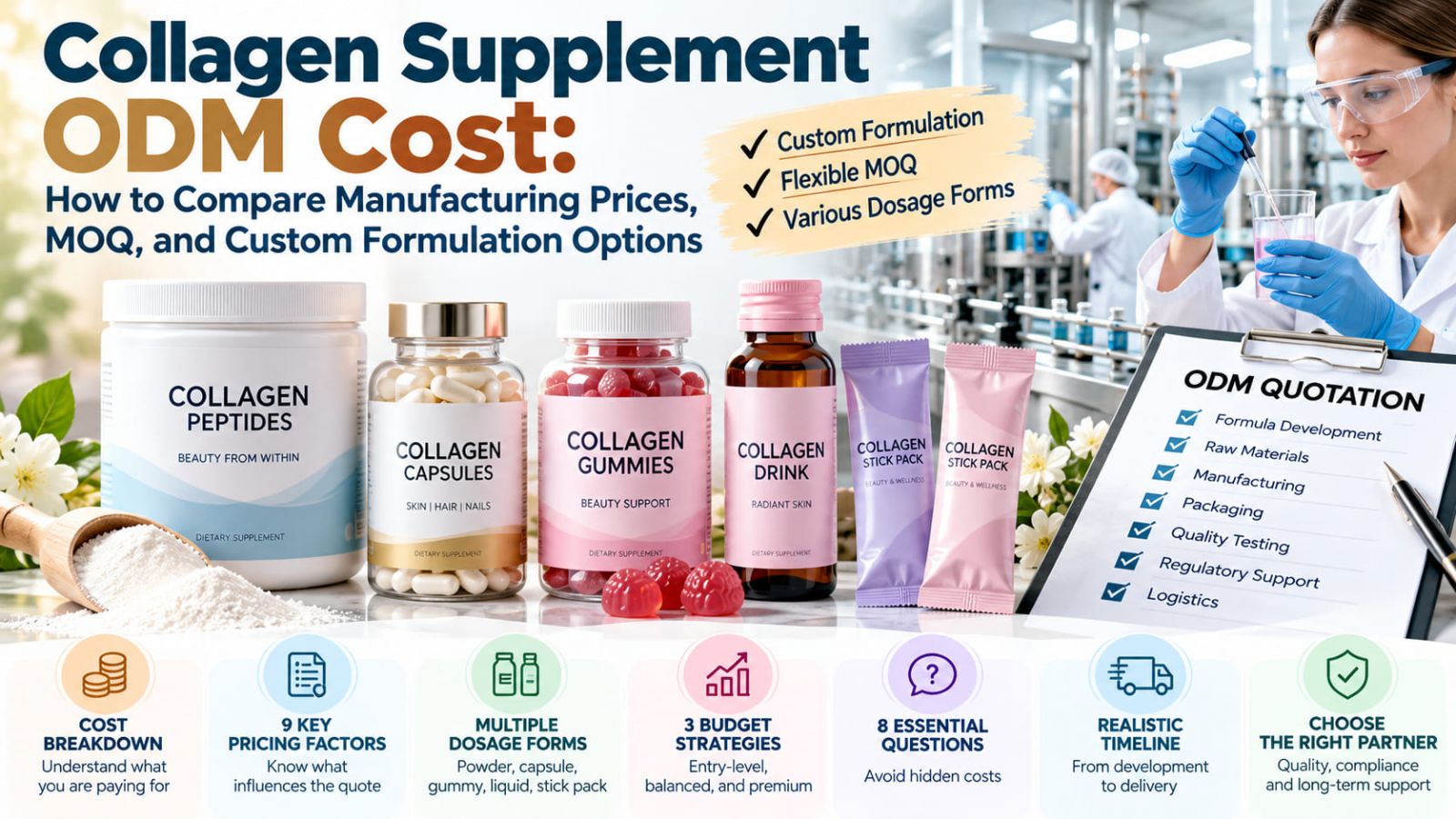
Collagen Powder vs. Capsules vs. Gummies vs. Liquid: Which Manufacturing Format Costs More?
Product format is one of the most important decisions in collagen supplement ODM development. The appropriate choice depends on the intended collagen dosage, target audience, consumer experience, manufacturing capability, and distribution model.
| Format | Manufacturing Considerations | Best-Fit Business Goals |
|---|---|---|
| Collagen Powder | Blending, flavor development, bulk filling, moisture protection. | Flexible serving sizes and larger collagen portions. |
| Collagen Capsules | Capsule shell selection, fill capacity, capsule count, bottling. | Portable supplements with smaller per-unit ingredient quantities. |
| Collagen Gummies | Texture development, flavor balancing, stability, moisture control. | Taste-oriented consumer products with dosage limitations. |
| Liquid Collagen | Liquid processing, packaging compatibility, microbial controls, stability. | Convenient ready-to-consume products. |
| Collagen Stick Packs | Unit-dose filling, printed film, sealing, individual-pack inspection. | Travel-friendly and subscription-oriented supplement formats. |
Powder products can offer a relatively straightforward manufacturing pathway for large collagen servings. Gummies and liquids may introduce additional processing or stability requirements. However, no format is universally the cheapest. Actual pricing depends on product specifications, equipment, packaging, and volume.
3 Collagen Supplement ODM Budget Strategies: Entry-Level, Balanced, and Premium
Rather than selecting an arbitrary manufacturing budget, brands should define what they need from their first commercial product. The following three approaches can help buyers align development investment with market positioning and financial risk.
Strategy 1: Entry-Level Budget — Minimize Development Complexity
This approach is suitable for startups testing consumer demand, businesses introducing a small supplement line, or retailers seeking a branded collagen product without an extensive development program.
- Consider an established collagen formula.
- Use standard packaging where appropriate.
- Limit unnecessary ingredient additions.
- Compare manageable MOQ options.
- Budget for required testing and labeling.
Main advantage: Lower formulation complexity and potentially faster development. The trade-off is reduced product differentiation.
Strategy 2: Balanced Budget — Invest in Meaningful Differentiation
A balanced ODM strategy is suitable for brands that want a recognizable product identity without financing excessive product development or sophisticated packaging from the beginning.
- Select collagen ingredients according to a documented specification.
- Customize flavor or complementary ingredients.
- Choose packaging that supports both protection and brand identity.
- Set realistic order quantities based on sales forecasts.
- Include appropriate quality and stability assessments.
Main advantage: A practical balance between unique brand positioning, controlled investment, and scalable manufacturing.
Strategy 3: Premium Budget — Build a Distinctive Custom Product
Premium collagen supplement ODM projects may suit established brands, international distributors, or businesses targeting a specialized consumer segment with distinctive formulation and packaging requirements.
- Develop a custom collagen formula and sensory profile.
- Specify advanced ingredient or traceability requirements where justified.
- Consider specialized packaging and unit-dose systems.
- Plan additional formulation validation and testing as needed.
- Build a repeat-order and supply continuity strategy.
Main advantage: Greater flexibility and differentiation. The trade-off is higher development complexity and potentially larger initial investment.
8 Essential Questions to Ask Before Accepting a Collagen Supplement ODM Quote
A transparent manufacturing quotation should explain the specifications, commercial obligations, and conditions under which pricing may change. Before approving an ODM supplier, buyers should obtain clear answers to the following questions.
- What exactly is included in the unit price? Confirm whether the quotation covers raw materials, manufacturing, primary packaging, labeling, and final packing.
- What is the MOQ for each product format and formula? Ask whether minimum quantities apply per SKU, flavor, packaging variation, or production batch.
- Are formulation development and samples included? Clarify sample fees, revision limits, intellectual property arrangements, and additional development charges.
- Which laboratory tests and quality documents are provided? Request a list of standard batch release testing and optional third-party testing.
- Can packaging and labeling be customized? Confirm printing requirements, packaging costs, lead times, and artwork approval responsibilities.
- What is the complete production and delivery schedule? Distinguish sampling, material procurement, manufacturing, quality release, and international delivery.
- What payment terms apply? Verify deposits, balance payments, accepted payment methods, currency, and refund or cancellation provisions.
- Which costs could be added after the initial quotation? Identify possible charges for packaging changes, repeat testing, expedited processing, freight, customs, and order modifications.
These questions help buyers evaluate more than the quoted unit cost. They also reveal the manufacturer's communication practices, technical capabilities, and willingness to establish clear commercial terms.
Collagen Supplement ODM Development Process and Production Timeline
Product development timelines vary according to customization, ingredient availability, testing requirements, packaging readiness, and factory capacity. An existing private label product may move through development faster than a new collagen supplement requiring multiple formulation and sensory trials.
Step 1: Product Brief and Project Evaluation
Define target customers, collagen source, serving size, product format, destination market, price objective, and estimated order volume. The manufacturer evaluates feasibility and identifies potential cost drivers.
Step 2: Formula Development and Sampling
The development team prepares a proposed formula and samples where applicable. Flavor, texture, mixing performance, ingredient compatibility, and other specifications may require review before approval.
Step 3: Final Quotation and Commercial Approval
Once the formula, packaging, and order quantity are defined, the manufacturer can prepare a more accurate quotation. Both parties should confirm specifications, payment milestones, change controls, and responsibilities.
Step 4: Raw Material and Packaging Procurement
Approved ingredients and packaging materials are purchased or allocated. Custom printing, specialty ingredients, and supply constraints may extend this stage.
Step 5: Manufacturing and Quality Control
The approved product is manufactured according to applicable procedures and specifications. In-process controls, finished-product testing, and batch documentation support quality review and release.
Step 6: Packaging, Shipment, and Delivery
Finished products are packaged, inspected, and prepared for shipment. International buyers should also account for export documentation, customs clearance, import requirements, and final warehouse delivery.
Some manufacturers can complete standard projects within several weeks after final approvals, while more complex ODM developments may take several months. These are planning considerations rather than guaranteed delivery commitments. A reliable quotation should provide project-specific milestones.
Common Collagen Supplement ODM Cost Mistakes and Hidden Expenses
Comparing Prices Without Matching Product Specifications
Comparing two collagen supplement quotations without reviewing the formula can lead to misleading conclusions. One product may contain a different quantity of collagen, a different ingredient grade, or a different number of servings.
To make a meaningful comparison, request quotations based on the same specifications whenever possible. Review both cost per finished unit and cost per serving.
Ignoring Development and Packaging Setup Charges
Custom formulas and packaging may involve development charges, tooling, printing setup, artwork adjustments, or minimum material purchases. These costs should be separated from recurring production costs so brands can evaluate both initial launch investment and future reorder economics.
Choosing a Larger MOQ Only to Reduce Unit Price
Higher order volumes may reduce unit manufacturing costs, but they also increase inventory exposure, storage requirements, and working capital commitments. For a new brand, purchasing a quantity that realistically matches expected demand may be more important than obtaining the lowest available unit price.
Overlooking Regulatory and Quality Responsibilities
Manufacturers may offer documentation support, but this should not be interpreted as automatic approval for every destination market. Import rules, labeling requirements, permitted ingredients, and product claims must be reviewed for the intended jurisdiction.
Special attention is needed for animal-derived ingredients, including appropriate allergen declarations where applicable. Marketing should not imply that collagen supplements diagnose, treat, cure, or prevent disease unless legally authorized under the applicable regulatory framework.
Forgetting the Total Landed Cost
International procurement costs can extend beyond the factory quotation. Freight, cargo insurance, import duties, taxes, customs brokerage, warehousing, and inland transportation may affect the actual cost of bringing a product to market.
A realistic budget should evaluate total landed cost rather than factory unit price alone. Buyers should also confirm the Incoterms used in the quotation to understand which shipping responsibilities belong to each party.
How to Choose the Right Collagen Supplement ODM Manufacturer
Selecting a collagen supplement manufacturer is a strategic procurement decision. Beyond the initial quotation, the manufacturer should be capable of consistently producing the agreed formula, maintaining documented quality controls, and supporting realistic production schedules.
Manufacturer Evaluation Checklist
- Verify manufacturing capability for the intended dosage format.
- Review applicable GMP systems and relevant certifications.
- Request raw material specifications and traceability information.
- Confirm quality testing, batch records, and documentation availability.
- Evaluate formulation development and sampling capabilities.
- Compare MOQ, unit pricing, and repeat-order conditions.
- Clarify formula ownership, confidentiality, and intellectual property terms.
- Confirm packaging capabilities and regulatory support scope.
- Evaluate communication, lead-time reliability, and corrective action procedures.
Certifications should be verified for validity, facility scope, and relevance rather than accepted solely on the basis of a supplier's promotional materials. Where commercially appropriate, buyers can request facility audit information or third-party inspection arrangements.
A strong collagen supplement ODM partnership should establish clear technical specifications, transparent pricing, and procedures for managing product changes. This helps both new and established supplement brands plan future production with greater confidence.
Collagen Supplement ODM Frequently Asked Questions
Q1: How much does collagen supplement ODM manufacturing cost?
Collagen supplement ODM costs vary according to collagen source, formulation complexity, serving size, dosage format, packaging, quality testing, and order quantity. A customized project may involve development costs in addition to unit manufacturing costs. Requesting a detailed quotation with defined specifications is the most reliable way to estimate a project budget.
Q2: What is the minimum order quantity for collagen supplement ODM?
MOQ depends on the manufacturer, formula, product format, packaging materials, and production equipment. Standard private label products may have lower minimum quantities than highly customized formulations. Ask suppliers for MOQ requirements per SKU and quotations at different order volumes.
Q3: Are there hidden fees in collagen supplement ODM quotations?
Additional expenses may arise from formula revisions, sample development, packaging setup, laboratory testing, special documentation, freight, or customs charges. A transparent quotation should identify included services, excluded costs, and conditions that may trigger additional charges.
Q4: How long does collagen supplement ODM development and delivery take?
Lead times vary with formula development, sampling, raw material availability, packaging production, manufacturing schedules, testing, and international shipping. Standard projects may take several weeks after approval, while complex ODM developments may require several months. Confirm a project-specific schedule with the manufacturer.
Q5: What payment terms do collagen supplement ODM manufacturers offer?
Payment terms differ between manufacturers. Some require a deposit before procurement or production and a remaining balance before shipment. Buyers should confirm payment milestones, currency, accepted methods, refund conditions, and any additional transaction charges before placing an order.
Q6: What is the difference between collagen supplement OEM and ODM?
OEM generally involves manufacturing a product according to specifications provided by the buyer. ODM may include formulation design, product development, sourcing, and manufacturing support. Service definitions differ by supplier, so buyers should confirm the scope of development and formula ownership.
Q7: Can I customize the ingredients in a collagen supplement ODM formula?
Many ODM manufacturers offer formulation customization, including collagen source, serving size, flavors, and complementary ingredients. Customization depends on ingredient compatibility, manufacturing feasibility, applicable regulations, and the manufacturer's technical capabilities.
Q8: Is marine collagen more expensive than bovine collagen?
Marine collagen may cost more than certain bovine collagen ingredients, but the comparison depends on peptide specifications, sourcing, processing, quality requirements, and purchase volume. Both ingredient types should be compared using equivalent technical and quality specifications.
Q9: What certifications and quality documents should an ODM manufacturer provide?
Buyers should review applicable GMP documentation, ingredient specifications, certificates of analysis, relevant test reports, traceability records, and other documents required for the destination market. Additional certifications may be relevant depending on the product and target customers.
Q10: How can I get an accurate collagen supplement ODM quotation?
Prepare a product brief covering the intended market, collagen source, formula requirements, serving size, dosage format, packaging preferences, estimated order quantity, target budget, and desired delivery date. The more complete the specifications, the easier it is for manufacturers to provide a meaningful quotation.